It is now officially spring. I have cleaned up the yard after the devastation of this winter. This winter should not have been bad, and wasn't that that, until that unusual cold front that hit us in February. Our Dec/Jan typical winter was pretty typical, and everything in the yard held up pretty well. A little tip burn on the more sensitive subtropicals, but nothing extreme. Then after the cold, things started to warm up for us in January to the point that almost every mango in the yard started flowering. But then in February we got a late cold front that brought the temperatures in my yard down to 26 F one night and hard freeze for 3 days. Every mango flower stalk turned black and died and the amount of damage was severe, most plants either dying outright or dying back to the trunk / complete defoliation. I had a papaya that had 3 dozen fruit on it that all froze. See below for the temperature plot in my yard
Since then I have been able to assess the damage. Most (but not all) things I had covered up survived and many with minimal damage. But every subtropical that was not covered took major damage. Every citrus tree looks great and took no damage. And because of all the chill, the deciduous fruits all bloomed very strongly. So like with most AZ winters: A very mixed bag.
Documenting the progress of our backyard orchard in Chandler, AZ (east valley of greater Phoenix area). I am Mark (starch on TFF and ourfigs). Use the navigation list to the right to get the details on what is growing in the yard (Mobile users: use drop down list below).
Friday, March 20, 2020
Friday, August 23, 2019
Mango Harvest 2019
2019 was not a great year for mango production in my yard. I had way more mangos in 2018, but this winter was very harsh. As an example I got 2+ dozen mangos off my Sunrise last year. But this year I didn't even get a flower off the tree because half of it died back this winter, including all the flowering tips. But despite the setbacks, I did get some really spectacular mangos this year. Here is the roundup of production:
| Cultivar | Quantity Produced |
| Angie | 1 |
| Bailey's Marvel | 1 |
| Cac | 1 |
| Gary | 1 |
| Ice Cream | 13 |
| Kathy | 3 |
| Lemon Meringue | 1 |
| Peach Cobbler | 3 |
| Springfels | 2 |
Thursday, August 15, 2019
Ripe Springfels Mango
Ate my first Springfels mango from my tree today. It was very good. It is described as a pineapple flavored mango. Pineapple Pleasure is one of my favorite mangos and is very pineapple-y. Springfels is not pineapple-y in the same way. It is more like a very rich classic mango (similar richness to Edward in my opinion) but has a pineapple background complement flavor that makes it a little more refreshing than eating a classic mango.
This is a big mango, like > 1 lb. I have another on the tree still ripening that is at least 2 lb. This one is reported to have a lot of growing and ripening issues in FL, but looks like it makes very good mangos in AZ.
Wednesday, May 15, 2019
Temporary Canopy Trees (Permaculture Approach)
A cornerstone permaculture design approach is to use fast growing trees as temporary canopy until productive trees grow into to take that space in the canopy layer. In the Phoenix desert this becomes almost a requirement (I say almost because you can throw extra water and build temporary shade structures to keep trees alive when there is no natural canopy around, but that is the hard way to go about it). When you use other trees as temporary shade, you get many more benefits than just building shade structures:
However this does require you to think ahead and get your temporary trees established first before you start planting your orchard. This really does pay off in the long run.
I have been putting this approach to good use for years in my yard. I use Moringa and Castor (Giant Zanibariensis) as fast growing canopy trees. And after 1-3 years I take them out once something becomes big enough to occupy that space. I have removed several trees this way. Today I removed two more.

Castor and Morninga were planted side by side to provide shade in my deciduous area. Castor was about 15 ft tall and Moringa was 25+ ft tall and provided significant shade. A Sweet Lavender Mulberry was planted in this area to be a productive tree that eventually provided the canopy in this area. Now that the Mulberry is big enough the Castor and Moringa have been stumped.
- Will make shade, without needing to stake any structure or worrying about it blowing away in a wind storm
- Will create a microclimate in that section of the yard far more effectively than a shade structure will
- Will add fertility to the soil by making bacterial and fungal associations and multiplying that content in the soil via increased root mass (especially true if the trees are nitrogen-fixing)
- Will create free mulch via natural leaf dropping or intentional pruning
- Will create a nurse environment for a productive tree
- Nursed productive trees will establish faster due to the increased microbial activity in the soil
However this does require you to think ahead and get your temporary trees established first before you start planting your orchard. This really does pay off in the long run.
I have been putting this approach to good use for years in my yard. I use Moringa and Castor (Giant Zanibariensis) as fast growing canopy trees. And after 1-3 years I take them out once something becomes big enough to occupy that space. I have removed several trees this way. Today I removed two more.

Castor and Morninga were planted side by side to provide shade in my deciduous area. Castor was about 15 ft tall and Moringa was 25+ ft tall and provided significant shade. A Sweet Lavender Mulberry was planted in this area to be a productive tree that eventually provided the canopy in this area. Now that the Mulberry is big enough the Castor and Moringa have been stumped.
Monday, May 13, 2019
Mid-May Update
Lots of fun stuff in the yard right now:

Tahitian pummelo! Second year of fruiting for me. Right now they are tennis ball size but when ripe will be the size of a women's basketball

Tons of figs all over the yard. In this pic: Genovese Nero (AF) in the front and Ronde de Bordeaux in the back

Tahitian pummelo! Second year of fruiting for me. Right now they are tennis ball size but when ripe will be the size of a women's basketball

Tons of figs all over the yard. In this pic: Genovese Nero (AF) in the front and Ronde de Bordeaux in the back
Wednesday, May 8, 2019
Moringa Airlayering Experiment, part 2
This is follow up to Moringa Airlayering Experiment, part 1
It has been a month so it is time to check the air layer experiment. Here is what the branch looks like on the tree. Look how much the moringa has leafed / branched out in just a month.
I cut the branch off the tree and put it on the ground so I could get a look at it.
Opened up the airlayer ball .... nada. No roots and nothing that looks like root initials.
As a point of comparison, I did a Fig air layer about a week after I started this moringa air layer and the fig air layer is already full of roots. The temperature has been perfect over the last month for air layering. So if it was ever going to work, it should have worked in the last month.
So even though the air layering experiment was not successful, I cut the branch to 6 ft tall and stuck it in a pot. It will likely root (morningas root fairly easily). But this is why we experiment :)
It has been a month so it is time to check the air layer experiment. Here is what the branch looks like on the tree. Look how much the moringa has leafed / branched out in just a month.
I cut the branch off the tree and put it on the ground so I could get a look at it.
Opened up the airlayer ball .... nada. No roots and nothing that looks like root initials.
As a point of comparison, I did a Fig air layer about a week after I started this moringa air layer and the fig air layer is already full of roots. The temperature has been perfect over the last month for air layering. So if it was ever going to work, it should have worked in the last month.
So even though the air layering experiment was not successful, I cut the branch to 6 ft tall and stuck it in a pot. It will likely root (morningas root fairly easily). But this is why we experiment :)
Wednesday, April 24, 2019
Updated Plant Catalog
Last year (both the summer of 2018 and the winter of 2018/19) were some of the hottest and coldest my yard had to experience. There are quite a few trees and plants that did not make it. So I updated the catalog of links on the right of the page to remove the plants that did not make it and added a new DIED section. I feel like this is important documentation; To not only show the success in the yard, but also the failures (which can be instructive) when trying to do zone pushing in the desert.
Tuesday, April 23, 2019
Spring Update 2019
I am doing a large yard update for spring 2019. Most everything that is not dead and will eventually recover from our winter is already recovering. So I took a lot of photos ... bring on the deluge!
(Left) Fig area (10+ varieties)
(Right) Garden: Tomatoes, peppers, radishes, carrots, watermelon, potatoes, wildflowers, etc.

Mango Area 1. This was an interesting experiment. This was uncovered during the winter. Castor is interplanted between mangos for canopy (cut back to 2 ft tall in spring). Lots of damage in this area. 1 mango dead, 5 others severely damaged. This area got a lot of cold. But 2 mangos really stood out: 1) Bailey's Marvel (this one has a reputation for being slightly more cold tolerant and my experience confirms that) and 2) Kathy / K-3 (Took absolutely no damage whatsoever. This one was a very nice surprise!)
(Left) Persimmon. Loaded with flowers and has already set a ton of fruit.
(Right) Norris Che. Also loaded with fruit

Mango Area 2 as well as a bunch of other stuff in pots (Garcinias, Eugenias, Diospyros, Citrus, etc.)

This is just fun. Part of my 'lawn' (which is mostly clover with some Bermuda intermixed) and the edge of my pool deck that I have put in a several 'bright-edge' yucca and interplanted some creeping oregano. I like the color and texture contrast.
(Left) View of the eastern end of pool (western exposure): Orange, Olives, Natal Plums
(Right) View to the west from eastern edge of pool, rest of the "food forest"

Hybrid Torch cactus. I got this one from my friend Ken in Tucson. Everytime I look at these beautiful flowers, I can't stop smiling!!
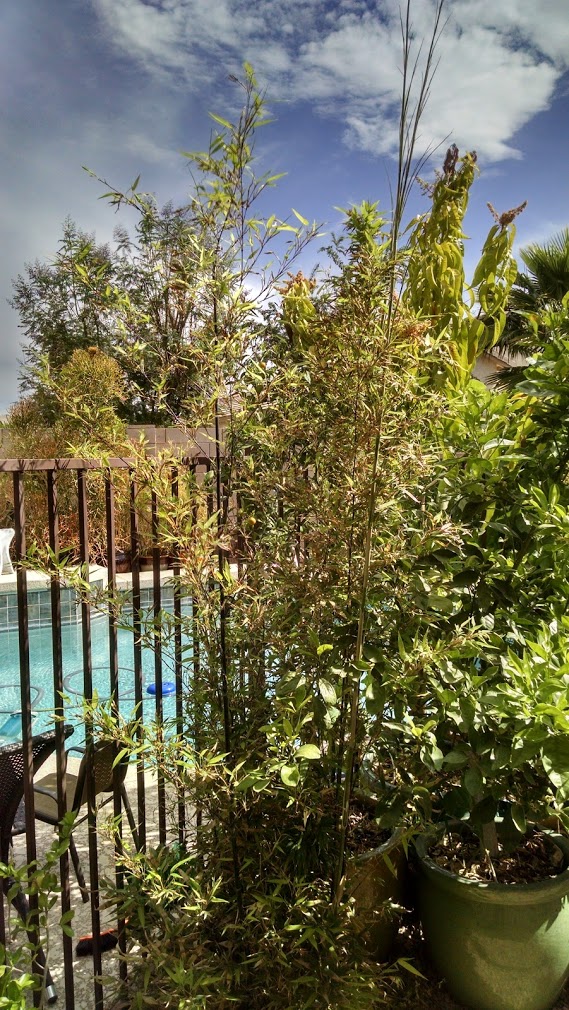
(Left) Black Bamboo making a big spring growth push
(Right) Deciduous area, fully leafed out an looking great
(Left) Fruit Punch mango is absolutely loaded this year
(Right) Floridaprince peach is so loaded with fruit that I have thinned several times and cut branches to keep the tree stable
(Left) Neem tree is leafing out again. Neem is evergreen in my yard most years, but this winter it completely defoliated
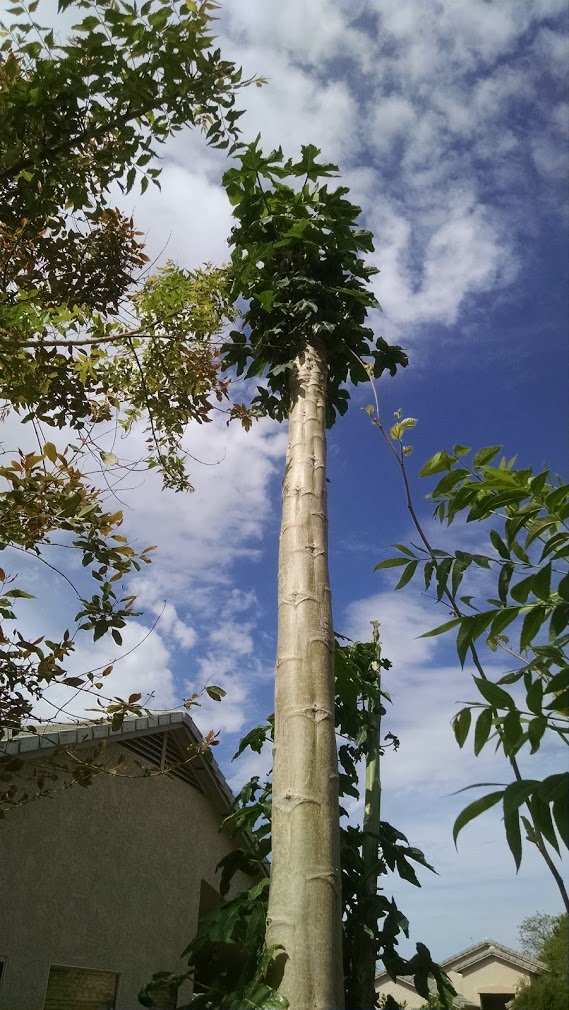
(Right) Tainung #2 Papaya leafing out again
Black Star Surinam Cherry, already flowered and has set a crop. The fruit off this one is *so* good!
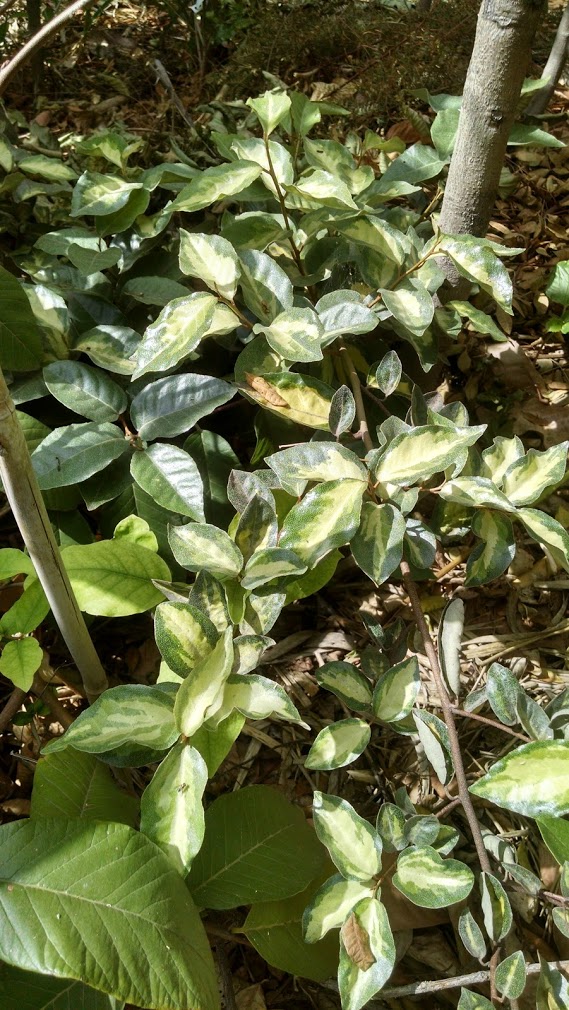
(Left) Golden Silverberry has incredibly beautiful foliage and is really spreading out now
(Right) Mangos, Avocados and Lychee. The Coconut Cream mango was huge but took severe damage this winter. It is leafing out from the trunk. The Brewster lychee took no damage, looks great and is putting out flower buds.
(Left) Annona area. All the Annonas defoliated and many took lots of damage. Only the Rollinia deliciosa actually died. But the rest are leafing out again.
(Right) Geffner Atemoya is looking great. I am training it up the trunk of the Jamaican Cherry like a trellis.
Sunrise mango hit hard this winter, lost about 50% of tree. Leafing out well. I got over 2 dozen mangos off it last year but this year will be a recovery year for it.
Feijoas / Pineapple Guavas starting to bloom. Very striking. Flower petals taste like tropical marshmallows (not joking).
(Left) Lychees are doing great. No damage at all during the winter and are leafing and blooming with a vengenace
(Right) Closeup of the flower stalks on my Sweetheart.
(Left) Longans looking lovely
(Right) Pouterias looking great! Here is the Fairchild II Canistel and Pace Mamey Sapote. The very large Ross Sapote did not make it through the winter :( . This was my most heartbreaking loss.
(Top) View inside Pakistan Mulberry
(Left) Loaded with fruit!
(Right) These truly are an incredible spring treat. Those who don't grow them really don't know what they are missing.
(Left) Bananas: Dwarf Namwah, Pitogo, Raja Puri, Dwarf Orinonco, and Hom (from Doug Jones)
(Right) Dwarf Namwah pup
(Left) A few papaya seedlings that were ready to go in the ground (Red Lady #786 and Wild Papaya)
(Right) A close look a the Wild Papaya. Very thick base. Striated trunk that almost looks like bark. Weird long arrow shaped leaves. Very cool little dude.
(Left) Fig area (10+ varieties)
(Right) Garden: Tomatoes, peppers, radishes, carrots, watermelon, potatoes, wildflowers, etc.

Mango Area 1. This was an interesting experiment. This was uncovered during the winter. Castor is interplanted between mangos for canopy (cut back to 2 ft tall in spring). Lots of damage in this area. 1 mango dead, 5 others severely damaged. This area got a lot of cold. But 2 mangos really stood out: 1) Bailey's Marvel (this one has a reputation for being slightly more cold tolerant and my experience confirms that) and 2) Kathy / K-3 (Took absolutely no damage whatsoever. This one was a very nice surprise!)
(Left) Persimmon. Loaded with flowers and has already set a ton of fruit.
(Right) Norris Che. Also loaded with fruit

Mango Area 2 as well as a bunch of other stuff in pots (Garcinias, Eugenias, Diospyros, Citrus, etc.)

This is just fun. Part of my 'lawn' (which is mostly clover with some Bermuda intermixed) and the edge of my pool deck that I have put in a several 'bright-edge' yucca and interplanted some creeping oregano. I like the color and texture contrast.
(Left) View of the eastern end of pool (western exposure): Orange, Olives, Natal Plums
(Right) View to the west from eastern edge of pool, rest of the "food forest"

Hybrid Torch cactus. I got this one from my friend Ken in Tucson. Everytime I look at these beautiful flowers, I can't stop smiling!!
(Left) Black Bamboo making a big spring growth push
(Right) Deciduous area, fully leafed out an looking great
(Left) Fruit Punch mango is absolutely loaded this year
(Right) Floridaprince peach is so loaded with fruit that I have thinned several times and cut branches to keep the tree stable
(Left) Neem tree is leafing out again. Neem is evergreen in my yard most years, but this winter it completely defoliated
(Right) Tainung #2 Papaya leafing out again
Black Star Surinam Cherry, already flowered and has set a crop. The fruit off this one is *so* good!
(Left) Golden Silverberry has incredibly beautiful foliage and is really spreading out now
(Right) Mangos, Avocados and Lychee. The Coconut Cream mango was huge but took severe damage this winter. It is leafing out from the trunk. The Brewster lychee took no damage, looks great and is putting out flower buds.
(Left) Annona area. All the Annonas defoliated and many took lots of damage. Only the Rollinia deliciosa actually died. But the rest are leafing out again.
(Right) Geffner Atemoya is looking great. I am training it up the trunk of the Jamaican Cherry like a trellis.
Sunrise mango hit hard this winter, lost about 50% of tree. Leafing out well. I got over 2 dozen mangos off it last year but this year will be a recovery year for it.
Feijoas / Pineapple Guavas starting to bloom. Very striking. Flower petals taste like tropical marshmallows (not joking).
(Left) Lychees are doing great. No damage at all during the winter and are leafing and blooming with a vengenace
(Right) Closeup of the flower stalks on my Sweetheart.
(Left) Longans looking lovely
(Right) Pouterias looking great! Here is the Fairchild II Canistel and Pace Mamey Sapote. The very large Ross Sapote did not make it through the winter :( . This was my most heartbreaking loss.
(Top) View inside Pakistan Mulberry
(Left) Loaded with fruit!
(Right) These truly are an incredible spring treat. Those who don't grow them really don't know what they are missing.
(Left) Bananas: Dwarf Namwah, Pitogo, Raja Puri, Dwarf Orinonco, and Hom (from Doug Jones)
(Right) Dwarf Namwah pup
(Left) A few papaya seedlings that were ready to go in the ground (Red Lady #786 and Wild Papaya)
(Right) A close look a the Wild Papaya. Very thick base. Striated trunk that almost looks like bark. Weird long arrow shaped leaves. Very cool little dude.
Subscribe to:
Posts (Atom)